Property is a lifetime portfolio, not a single purchase.
The Property Wealth Planning Framework is how ProjectHome.sg guides Singaporeans from their first property assessment to a portfolio that stays aligned with life. Three stages. One integrated advisory journey.
Book a 30-minute Zoom consultation
Most property decisions are reactive. Yours don’t have to be.
Most Singaporeans buy their first home reactively, then react again to every property decision that follows. A BTO becomes a resale. A resale becomes an upgrade. An upgrade becomes an investment. Each move handled in isolation, each decision made under time pressure.
The PWP Framework replaces reaction with intention. It treats property as a portfolio to be planned, executed, and reviewed over a lifetime.
Every stage of the framework is designed to be assessed and guided by a ProjectHome.sg advisor. Because the cost of a wrong step at any stage compounds long after the transaction closes.
Three stages. One integrated advisory journey.
Progression is linear. Review is continuous. Every stage is guided.
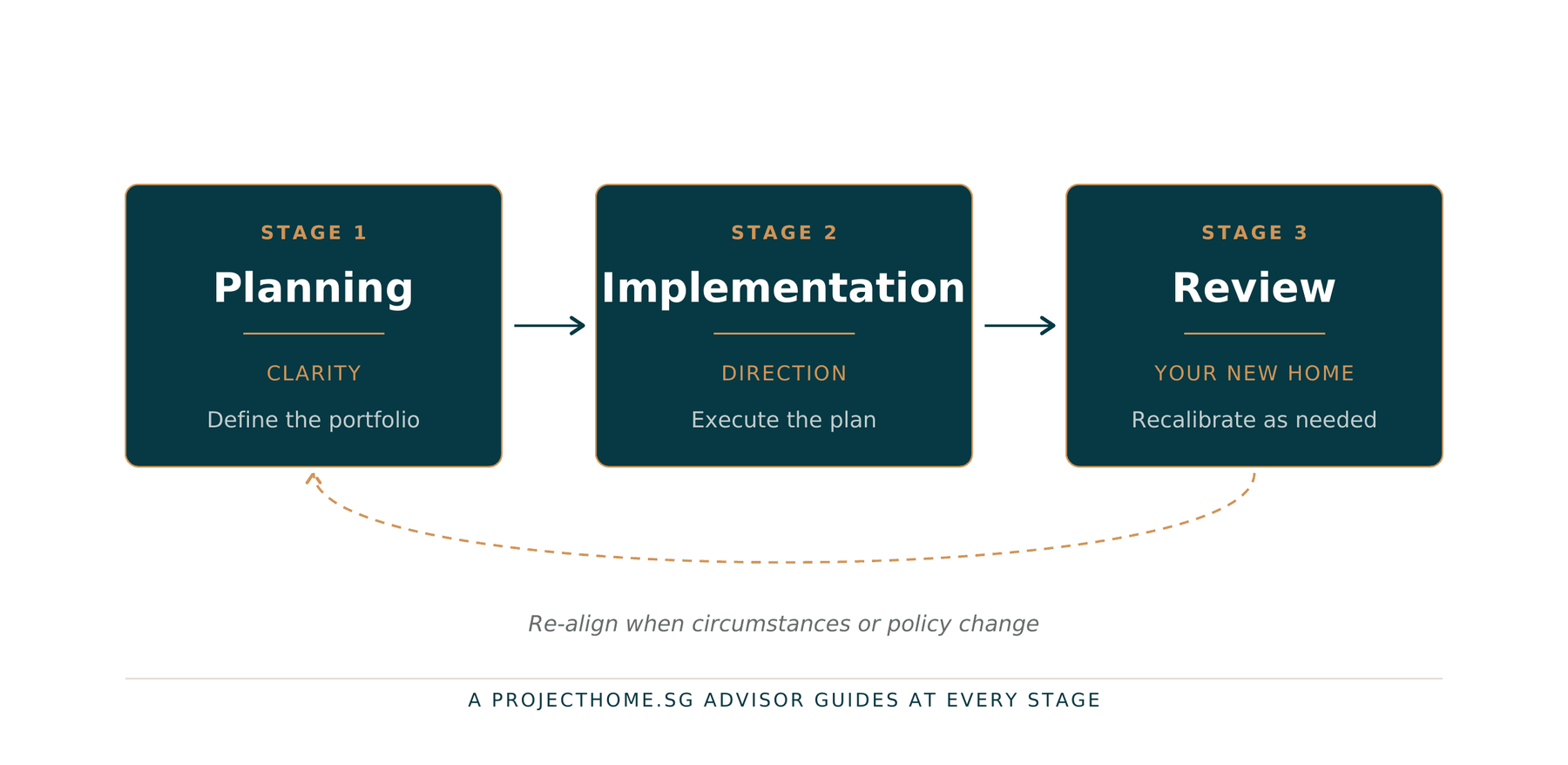
The Planning Stage
ClarityFor anyone new to property, or without a defined long-term property strategy. This is where the shape of your future portfolio is drawn before a single dollar is committed.
What we assess
- Portfolio vision. The intended end state (own-stay plus rental, legacy landed, retirement monetisation).
- Financial baseline. Income stability, CPF balances, cash reserves, debt load, risk tolerance.
- Life stage and timeline. Property moves mapped against career, family, and retirement milestones.
- Name and ownership structure. Single or joint name, decoupling readiness, ABSD exposure.
- Housing typology path. HDB, EC, private, landed, and the transitions between them.
- Stress-test scenarios. Interest rate rises, income disruption, market corrections.
Why this stage needs guidance
- The most expensive property errors originate here, not at the transaction.
- Decoupling costs and ABSD traps are near-impossible to unwind retrospectively.
- A structured plan replaces emotional or reactive buying with intentional decisions.
- Family alignment (spouse, parents, in-laws) is planned in, not fought over on balloting day.
The Implementation Stage
DirectionFor buyers who have completed Stage 1 and are ready to transact. Execution with discipline, coordinated across financing, timing, and paperwork.
What we execute
- Route selection. New launch or resale, each with its own sub-guide.
- Financing execution. IPA, loan structuring, TDSR and MSR compliance.
- Offer and negotiation strategy. Entering at the developer’s early-stage launch price, reading seller motivation, and counter-offer handling.
- Timing coordination. Sell-first or buy-first, bridging loans, temporary accommodation.
- Transaction milestones. Booking fee, OTP, Progressive Payment Scheme, TOP, CSC.
- Documentation and legal. Conveyancing, BSD and ABSD, CPF withdrawal, HFE compliance.
Why this stage needs guidance
- Execution errors carry hard financial penalties (missed deadlines, wrong declarations).
- Coordinated timing between sale and purchase directly reduces bridging and holding costs.
- New launch preparation begins days or weeks before balloting day, not on it.
- Sub-guides (like the pre-balloting readiness checklist) sit inside this stage as tactical playbooks.
The Review Stage
Your new homeFor owners already progressing toward, or holding, their target portfolio. Recalibration when policy, circumstance, or performance shifts the ground beneath the original plan.
What we review
- Policy impact. Cooling measures, ABSD, LTV, CPF rule changes, EC privatisation timelines.
- Personal circumstance. Income shifts, career changes, family changes, health events.
- Portfolio performance. Here, we conduct a “health check” on the actual projected yield, appreciation, and holding cost.
- Financing cycles. Refinancing every 2 to 3 years, interest rate re-optimisation.
- Exit and monetisation. When to sell, downsize, right-size, or unlock equity for retirement.
- Legacy and succession. CPF nomination, wills, property succession considerations.
Why this stage needs guidance
- External factors change faster than most owners can track independently.
- A well-timed refinancing alone can save five-figure sums annually.
- The plan set at Stage 1 must stay relevant across a 20 to 30 year horizon.
- Review triggers (MOP, TOP, refinancing window, retirement, policy change) are anticipated, not missed.
Start with clarity.
A 30-minute Zoom consultation is the first step of Stage 1. No sales pitch, no inventory push. Just a structured conversation about where you stand, and where you want your property portfolio to take you.